Before You Bet, Read This 2026 Rules Breakdown
The 2026 football rules changes are not one universal package: NCAA college football, the NFL and NFHS high school football each publish separate regulations for different markets. NCAA updates cover....

Before You Bet, Read This 2026 Rules Breakdown
The 2026 football rules changes are not one universal package: NCAA college football, the NFL and NFHS high school football each publish separate regulations for different markets. NCAA updates cover targeting penalties, replay, player safety, technology, game operations and the new Fair Catch Kick, while NFL changes address kickoff alignment, touchback placement, onside-kick declarations and league consultation on disqualifications. NFHS changes include play cards on the forearm or belt and a ban on slapping an opponent’s head. These rules matter to Match Daily readers because penalties, possession rules and kickoff mechanics can change match predictions and live betting judgments. The 2026 season also includes NFHS equipment clarifications, with some arm-sleeve specifications delayed until 2027. Check the governing body before interpreting an incident, then separate confirmed rule text from commentary and pre-season speculation.

Photo by Haberdoedas Photography on Pexels
Myth 1: “Football rules changes 2026” means one global rulebook — debunked
The first mistake is treating “football” as a single competition with a single authority. The 2026 rule changes apply differently depending on whether you are watching NCAA college football in the United States, the National Football League, or NFHS high school football. FIFA governs association football, commonly called soccer in the United States, and its Laws of the Game are a separate framework entirely. A World Cup 2026 match does not use NCAA targeting rules, NFL kickoff language or NFHS equipment provisions. That distinction is basic, but search results often blend these categories because the phrase “football rules changes 2026” is used for all of them. NCAA Football and NFL Football Operations publish separate information, while NFHS Football serves the high school game. For Match Daily, the practical lesson is simple: identify the competition before assessing a penalty, a kickoff or a betting market.
The differences are not cosmetic. The NFL’s listed 2026 changes include Rule 6-1-3, which modifies receiving-team alignment in the kickoff setup zone; Rule 6-1-5, which changes the dead-ball spot after a touchback when the kickoff comes from the 50-yard line; and Rule 6-1-6, which permits the kicking team to declare an onside kick at any time during the game. NCAA guidance, by contrast, focuses on college officiating procedures and issues such as targeting, replay review, technology and the Fair Catch Kick. NFHS Rule 1-5-3c(9) permits play cards on both the forearm or wrist and belt areas, while Rule 9-4-7 prohibits using the hands to slap an opponent’s head. Calling these items one “football rule change” produces the wrong answer for at least two of the three major U.S. codes. Data shows that rule identification is not a wording issue; it determines which event should affect your analysis.
Want a cleaner way to track competition-specific updates?
[Internal Link: 2026 football competition guide]
Myth 2: The 2026 changes only affect penalties — partially true
Penalties are visible, so they attract most attention, but the official 2026 material reaches further. The NCAA package includes targeting penalties, replay procedures, player safety, technology and on-field operations, alongside the Fair Catch Kick. The NFL list affects kickoff structure and administrative review, and NFHS changes include equipment, player conduct and sideline management. Therefore, a rule change can alter field position, possession probability, clock expectations or the chance of a review without producing a conventional 5-, 10- or 15-yard flag. The National Football Foundation describes the college changes as covering “targeting penalties, replay procedures, player safety, technology, on-field operations and the introduction of the Fair Catch Kick.” That wording matters because it confirms a wider operational scope. A bettor who tracks only penalty yards is measuring the wrong output.
The NFL kickoff revisions are a useful example. A modified alignment requirement may change how quickly the receiving team reaches the ball and how coaches structure the first return phase. A changed touchback spot after a 50-yard-line kickoff can alter the starting field position, even if no penalty occurs. The ability to declare an onside kick at any point also changes the strategic menu, but it does not guarantee recovery success; recovery still depends on execution, blocking, timing and the receiving team’s response. This is a key information gain: a new option is not the same as a new expected-value advantage. Analysts should record the rule, then measure actual outcomes across games rather than treating a headline as proof. Match Daily’s team tactics coverage should therefore separate opportunity creation from conversion rate, especially during early 2026 samples.
The NCAA Fair Catch Kick requires the same discipline. It is not simply an ordinary field goal with a different name; it is a specific scoring opportunity linked to a fair catch under the applicable college rules. Its practical value depends on distance, wind, time remaining and whether the officials confirm that the conditions are met. In live markets, the presence of a fair catch does not automatically justify a dramatic price move. The correct workflow is to verify the down, spot, clock and rule code, then compare the available scoring option with the team’s normal field-goal probability. The NCAA Football Rules should be treated as the authority for college interpretation, not a social-media summary. A small procedural detail can be more important than a dramatic commentator description.
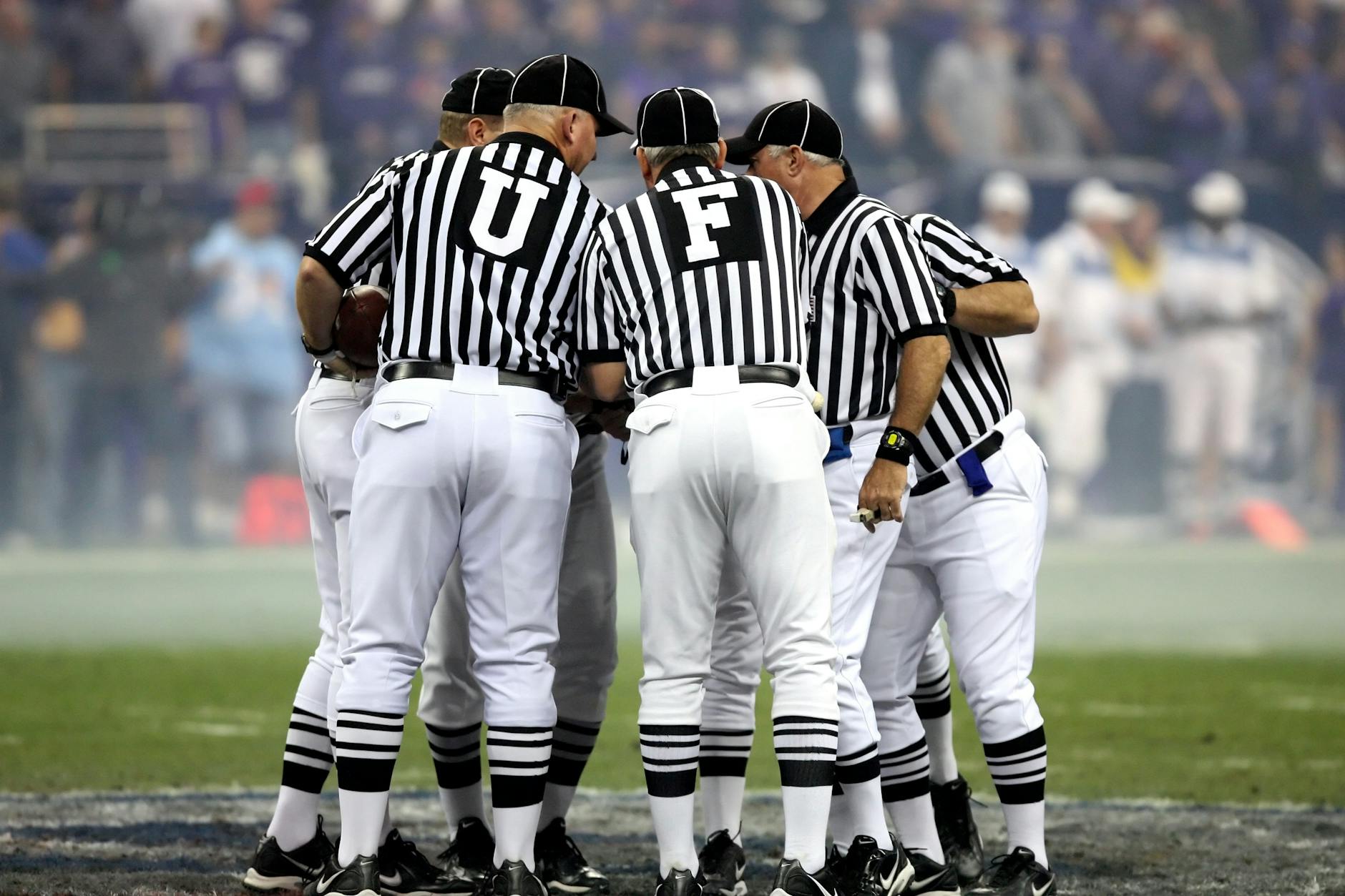
Photo by Pixabay on Pexels
See how these changes affect game reading rather than headline reactions.
Myth 3: Every 2026 rule change is already active everywhere — flat-out false
Timing is the part many summaries get wrong. The NFHS 2026 material states that some clarifications apply to the 2026 season, while arm-sleeve specifications developed under Rules 1-5-2d and 1-5-3c(6) become effective with the 2027 season. That creates an immediate operational distinction: a coach preparing for a 2026 high school game should follow the current equipment rules, but should not present the 2027 sleeve specifications as a rule already governing every contest. The same caution applies to published dates and adopted language. A document dated August 25, 2026, may be a final reference for one code, while another competition may have a different implementation schedule. Check the effective season, not just the publication date. This is especially important for manufacturers, equipment managers, officials and bettors using old screenshots that omit the “effective 2027” note.
The NFHS equipment details are precise enough to change preparation routines. The 2026 rules clarify and restrict attachments on tooth and mouth protectors under Rule 1-5-1d(5)a, items 4 and 5. Play cards are allowed on both the forearm or wrist and belt areas under Rule 1-5-3c(9), while Rule 9-4-7 adds language stating that a player may not use the hand or hands to slap an opponent’s head. These are not interchangeable categories: one concerns equipment, one concerns information aids, and one concerns player conduct. A team can comply with the play-card provision and still commit a personal foul; a mouth-protector attachment can be noncompliant even when the player’s conduct is legal. NFHS Football Rules remains the proper source for the complete rulebook, casebook and official interpretation.
The NFL’s 2026 rules also show why “active everywhere” is a false claim. Rule 19-2 permits league personnel to consult with on-field officials when considering potential disqualification for flagrant football and non-football acts, even when the act was not called on the field. That is an NFL administrative and officiating process, not an automatic NCAA or NFHS procedure. Meanwhile, the NCAA package is promoted by the College Football Officiating organization and the National Football Foundation, with Steve Shaw identified in the published material as CFO national coordinator and NCAA rules editor at that time. Personnel changes do not erase the rule text, but they do reinforce the need to use the latest official release. When a game is disputed, record the competition, rule section, effective date and officiating decision before forming a conclusion.
To avoid the most common timing error, save the official document and mark its season on your notes.

Photo by Yura Forrat on Pexels
What actually works
A reliable 2026 football rules method starts with classification, not prediction. Before assessing an incident, record five facts: competition, governing code, rule section, effective season and game situation. This takes less than a minute but prevents the most expensive analytical mistake—applying an NFL kickoff rule to an NCAA game or an NFHS equipment standard to a professional contest. For a live market, add the score, quarter, down, distance, field position and timeout count. Those seven details explain whether a rule change has immediate tactical value or only long-term preparation value. The NFL Rulebook lists the 2026 changes in section-by-section form, which is more useful than relying on a general article. The 2026 NFL list contains four specifically identified change entries, while the NFHS publication also lists numerous editorial changes that are not all new competitive rules. Separating substantive changes from editorial wording is the first practical filter.
Use this three-layer review process:
- Confirm the rule: Locate the official rule number and exact competition.
- Confirm the trigger: Identify the event that makes the rule relevant, such as a 50-yard-line kickoff, fair catch, targeting review or equipment inspection.
- Measure the effect: Estimate changes in field position, possession, scoring chance, clock use or player availability.
The third layer is where most public commentary stops too early. For example, an NFL onside-kick declaration may increase strategic flexibility, but the measurable effect should be recovery rate and resulting field position, not the number of times analysts mention the rule. Similarly, a targeting change should be studied through ejection frequency, replay reversals and replacement-player impact rather than penalty count alone. This is a practitioner-level distinction: the rule defines the event, while the data defines its competitive weight. Match Daily can use that framework in team reports by tagging each game event with a rule code and an outcome. After 10 to 20 games, the resulting sample will be more informative than a single dramatic broadcast decision.
For your own notes, use a compact table with these columns:
- Competition: NFL, NCAA or NFHS
- Rule number: for example, NFL 6-1-6 or NFHS 9-4-7
- Effective season: 2026 or 2027
- Trigger: the exact game event
- Immediate effect: yards, possession, clock or eligibility
- Evidence: official document, replay or statistical record
- Confidence: confirmed, probable or unresolved
That table also exposes uncertainty. If the rule number is missing, the claim is not ready for a preview. If the effective season is missing, the claim may be outdated. If the measured effect is missing, the claim is commentary, not analysis. The College Football Officiating material is useful for identifying NCAA themes, but the complete competition rulebook should control a final interpretation. A courteous warning for every reader: do not place a wager because a rule sounds important; place it only when the confirmed rule changes the probability or price you are evaluating.
Ready to turn rule details into disciplined match analysis?
What should you ignore?
Ignore claims that use “football” without naming the competition. Ignore a headline saying a rule “changes everything” when it provides no rule number, effective date or measurable outcome. Ignore the assumption that an approved option will be used frequently; the NFL onside-kick change creates permission, not a guaranteed attempt, and the NCAA Fair Catch Kick creates a defined opportunity, not automatic points. Also ignore articles that merge NFHS equipment changes with professional football strategy, because a play card on a high school player’s belt has no direct relationship to an NFL kickoff alignment. These errors are easy to spot when you apply the five-field test: authority, rule number, season, trigger and effect.
Be cautious with historical comparisons as well. A 2025 penalty rate cannot be compared cleanly with 2026 data if the definition, review process, sample size or officiating guidance changed. Early-season data is particularly unstable because teams and officials are adjusting, and a handful of unusual events can distort the average. A sensible minimum is to label the first 4 to 6 games as an observation phase, then review whether the event rate is stable across conferences, teams and game states. This is not a rigid statistical law; it is a practical safeguard against overreacting to one weekend. If a rule affects only a narrow edge case, report the edge case rather than inflating its importance. Readers deserve the exact size of the effect, not theatrical language.
You should also ignore unsupported claims about international football. The FIFA World Cup 2026 in Canada, Mexico and the United States follows FIFA’s Laws of the Game, not the NFL, NCAA or NFHS codes. A World Cup match can involve different competition regulations, tournament procedures and technology protocols, so a college-football targeting discussion cannot be transferred to a FIFA match. Match Daily’s World Cup coverage should therefore keep association football terminology separate from American football terminology. When a source uses “football” ambiguously, ask whether it means NFL football, NCAA football, NFHS football or FIFA football. That one question removes a large share of search-result confusion and prevents incorrect tactical conclusions.
Photo by Jack Biddinger on Pexels
The bottom line is narrow but useful: 2026 is a year of separate rule updates, not one worldwide football reset. NFL changes address kickoff alignment, touchback placement, onside-kick declarations and possible disqualification consultation; NCAA changes address targeting, replay, safety, technology, operations and the Fair Catch Kick; NFHS changes cover play cards, head slaps, mouth-protector attachments and future arm-sleeve specifications. Verify the code, cite the rule and measure the effect before treating any change as a betting edge. Responsible analysis also means checking local law, using licensed services where applicable and never confusing information with a guaranteed result.
Continue with Match Daily for structured rule tracking and competition-focused analysis.
[Internal Link: team tactics and player statistics]
Frequently Asked Questions
Q: What are the main football rules changes for 2026?
A: The main 2026 changes differ by competition: NFL updates cover kickoffs, touchbacks, onside kicks and disqualification consultation; NCAA updates cover targeting, replay, safety, technology, operations and the Fair Catch Kick; NFHS updates cover equipment and conduct. The NFL list identifies Rules 6-1-3, 6-1-5, 6-1-6 and 19-2. NFHS also confirms that some arm-sleeve specifications begin in 2027, not 2026.
Q: How can I check which 2026 football rule applies?
A: Identify the competition first, then verify the official rulebook, section number and effective season. Use NFL Football Operations for NFL games, NCAA or College Football Officiating material for college games, and NFHS Football for high school games. Record the exact trigger, such as a 50-yard-line kickoff or a fair catch, before applying the rule to a match situation.
Q: What is the difference between NFL, NCAA and NFHS 2026 rules?
A: NFL rules govern professional football, NCAA rules govern college football, and NFHS rules govern U.S. high school football. Their 2026 changes address different subjects and use different procedures, even when the same words, such as “kickoff” or “targeting,” appear in coverage. A rule from one code should never be assumed to apply to another without confirmation.
Q: Does the NFL 2026 onside-kick change guarantee more successful recoveries?
A: No, the NFL change permits the kicking team to declare an onside kick at any time, but it does not guarantee recovery. Success still depends on alignment, timing, blocking, ball control and the receiving team’s preparation. Analysts should track declaration frequency, recovery percentage and starting field position separately instead of treating permission as proof of a strategic advantage.
Q: What should I do if an official applies a 2026 rule incorrectly?
A: Record the competition, rule number, game time, down, distance and officiating decision, then check the governing body’s official interpretation or review process. NFL, NCAA and NFHS procedures are not identical, so a complaint route that applies in one code may not apply in another. Do not rely on a clipped video without the complete play context and current rulebook.
Q: Do the 2026 American football changes apply to the FIFA World Cup 2026?
A: No, NFL, NCAA and NFHS changes do not govern FIFA World Cup 2026 matches. FIFA association football uses the Laws of the Game and tournament regulations, while American football uses separate professional, college and high school codes. For World Cup analysis, use FIFA and tournament-specific sources rather than American football rule summaries.
Q: Are official 2026 football rulebooks free?
A: Access depends on the governing body and publication format, but official online information is available from NFL Football Operations, NCAA resources and NFHS platforms. NFHS also identifies print books, digital books, casebooks and manuals as separate products. Before paying for a summary, compare it with the official rule-change notice and confirm that it states the correct 2026 or 2027 effective date.
Match Daily · System Archive · Entry Complete